
Saint Mary's Catholic Primary School, Congleton
Nursery
I am Miss Lankester and I am the Nursery teacher! Our nursery is a calm and happy place, where children can explore, play and develop a lifelong love of learning. I am so excited to be teaching your children and supporting their growth and development this year!
Mrs Borg-Heffernan will be supporting Nursery this year. Miss Small will be teaching Nursery on a Thursday afternoon for PPA cover.
To enquire about a place in Nursery, please click here.
Welcome Information
Our Nursery Day
08:35-08:45: Welcome children
08:45-9:00: Morning circle time
09:00-09:10: Dough Disco
09:10-10:00: Maths and free-flow continuous provision
10:00-10:15: Story time
10:15-10:30: Snack
10:30-10:45: Phonics
10:45-11:25: Small group work & free-flow continuous provision
11:25-11:40: Rhyme time
11:40-12:10: Lunch time
12:10-12:55: Outside
12:55-1:10: Afternoon input (Literacy/Understanding the World/RE)
1:10-2:45: Small group work & free-flow continuous provision
2:45-3:00: Celebration of the Word
3:00-3:15: Story time
What to bring to Nursery each day
- A waterproof coat
- Spare clothing: underwear, socks/tights, t-shirt/jumper, trousers/leggings
- Named water bottle with water
- Weather appropriate clothing (cold weather - coat, gloves, hat; warm weather - sun hat, please apply sun cream at home)
To keep at Nursery
- Wellies
- Puddle suit
**Please make sure all items of clothing are clearly labelled**
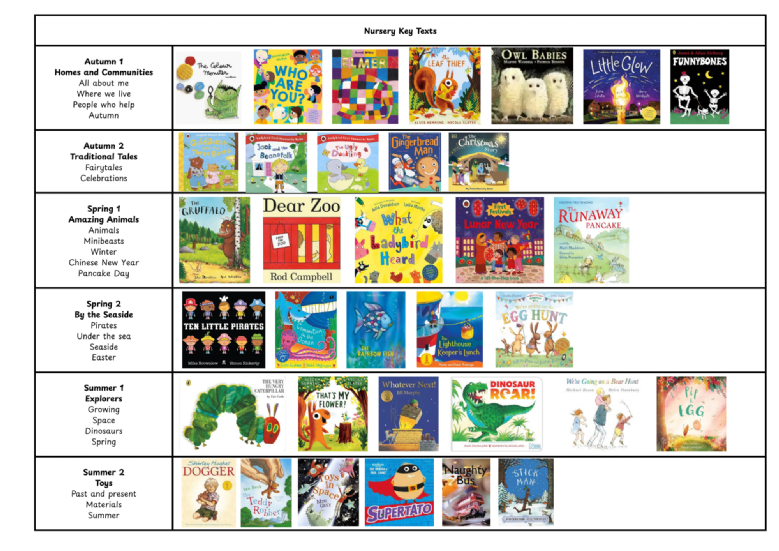
Our Yearly Reading List
Autumn 1
Our Autumn 1 topic is Homes and Communities. Our weekly themes and learning will be through the focus of high-quality texts:
- Who Are You?
- The Colour Monster
- Elmer
- Whatever Next
- The Leaf Thief
- Owl Babies
- Little Glow
- Funny Bones
We will be settling into Nursery, building relationships and making friends! The children will become familiar with school expectations and routines. We will be learning all about ourselves, our families and our community. Please see the topic map below for more information on our learning this half-term! You can help support your child's learning at home by reading stories and using key vocabulary 
Phonics
We use the Monster Phonics scheme at Saint Mary's. In Nursery, we teach Phase One and Pre-Phase Two. Phase One activities are arranged under seven aspects:
1. Environmental sounds
2. Instrumental sounds
3. Body Percussion
4. Rhythm and Rhyme
5. Alliteration
6. Voice Sounds
7. Oral Blending and Segmenting
Phase One phonics activities support children to listen attentively, grow their vocabulary, speak confidently, discriminate phonemes, audibly reproduce the phonemes they hear, and use sound-talk to segment words into phonemes.
Pre-Phase Two phonics introduces the children to grapheme-phoneme correspondences (GPCs). They learn the following: s, a, t, p, i, n, m, d.
Below is a useful video for teaching pure sounds: